
Passports & Microchipping
Passports
Following birth, legally, horses must be identified by both a passport and with a microchip inserted into the nuchal ligament. Horse passports are a human health measure to ensure that horse meat and products do not enter the human food chain if they have been treated with certain veterinary medicines.
All horse keepers must obtain individual passports for each horse they are responsible for. Passports must be obtained from an authorised Passport Issuing Organisation (PIO) – this is a legal requirement.
It is a single lifetime identification document which records the identity of a horse and contains information about the horse including certain veterinary medicines administered to it. A horse passport is not an ownership document. A horse must be identified by no later than 31st December in the year of its birth, or within 6 months of its birth.

How do I get a passport?
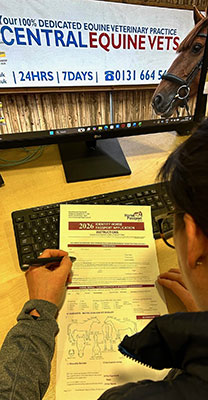
For a passport to be provided, the veterinary surgeon will complete a drawing and the relevant paperwork, inserting a microchip should the horse not already have one. Central Equine Vets will always issue a standard Horse Passport Agency form unless the owner provides a specific breed or society form for completion.
A valid passport should always remain with the animal and should accompany the horse when it is moved for the purposes of competition or breeding, on to the premises of a new keeper or for the purposes of receiving veterinary treatment.
All vaccines administered must be recorded in the passport and certified by a vet regardless of whether or not the horse is intended for human consumption.
Microchip
The Equine Animal (Identification) (Scotland) Regulations 2019 legislation requires all equines, regardless of age or status, to be accompanied by an identification document and implanted with a microchip. This will allow local authorities and the police to track the owners of abandoned, lost or stolen horses, so they can be reunited with their owners more easily.
How do I get a microchip?
Only a vet can implant your horse with a microchip. The vet, before implanting a microchip, will be required to ensure that the horse has not already been identified by insertion of a microchip. First, the horse is scanned to make sure that there is no existing microchip within the horse’s neck. The microchip, a small implant, about the size of a grain of rice, which contains a unique serial code is then inserted, via an injection, into the nuchal ligament, mid crest on the left side of the horse’s neck, sometimes under local anaesthetic. Once the microchip has been implanted, an electronic microchip reader can easily read it.
The horse owner’s details and a unique serial code are stored on a computerised database, which links the owner to the horse. It is therefore important that the owner’s details on the database are kept up to date.
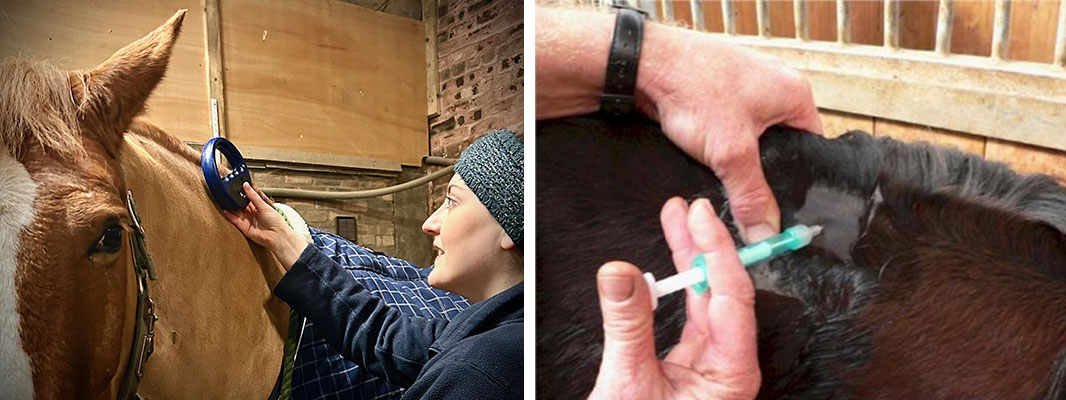
Holly Marshall scanning a horse to check the microchip | Microchip being inserted into the horse