
Sarcoids
If your horse has a lump or mass that is affecting the skin, we strongly recommend that you get it checked. Sarcoids are tumours of the skin. They are ‘contagious’ between horses that get sarcoids and are commonly spread by biting flies. They appear mainly in summer and grow in winter. (where a thicker, hairier coat makes them harder to detect)
There are four more common types of sarcoids; Occult, Verrucose, Nodular and Fibroblastic. A fifth type is the “malerolent” sarcoid – fast growing and aggressive but thankfully rarer. The sixth type is the “mixed” type combining any of the types.
All sarcoids can be difficult and expensive to treat and recurrence is likely. Early treatment gives the best results - if you catch them when they are small, the treatment time and outcome can be considerably improved.
Central Equine Vets works closely with Professor Derek Knottenbelt, founder of Equine Medical Solutions, a specialist in Equine Oncology, who has dedicated his life's work to this area. We work on a referral basis, whereby we perform the initial diagnosis and take extensive photographs and measurements of the lesions which, where necessary, then refer to Prof. Knottenbelt and his team and treatment options. Treatment for the lesions vary depending on which type of sarcoid is diagnosed, where the sarcoid lies on the horse's body and how big the lesion is.
Costs
As with all referrals, there is a referral fee involved. This will be added to your overall invoice following your initial consultation with Central Equine Vets. Following assessment of the lesion by Equine Medical Solutions, the treatment that is recommended will also carry a cost. These costs can vary, depending on what treatment is required. If you would like to have a better understanding of costs that may be incurred, please contact us and ask to speak to one of the vets, who will be able to discuss this with you further.

Treatment and Recovery Time
The recovery time of treating a sarcoid can vary, depending on what kind of sarcoid we are dealing with, how big the sarcoid is and where on the body the sarcoid is located. Please speak to your vet who can give you some indication for both treatment type and recovery times. The treatment options for sarcoids include radiation therapy, surgical removal, ligation or tying-off (also known as 'banding'), topical treatment and localised injections.
As sarcoids are a form of skin cancer, the success of its treatment can vary. Catching a sarcoid early can often be of great benefit in relation to treatment and recovery time as well as the success. We highly recommend that you do not delay in discussing equine skin lesions with your vet, as this could mean the difference between a successful and a less successful outcome.
Example 1. Girth sarcoid – removed surgically
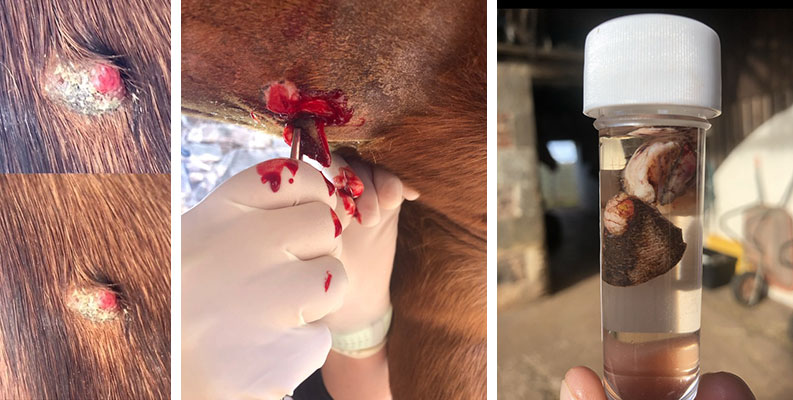
Verrucous sarcoid on the girth region | Surgical excision of the sarcoid | Sample sent to the lab for testing
Example 2. Girth sarcoid – treating with AW5 cream
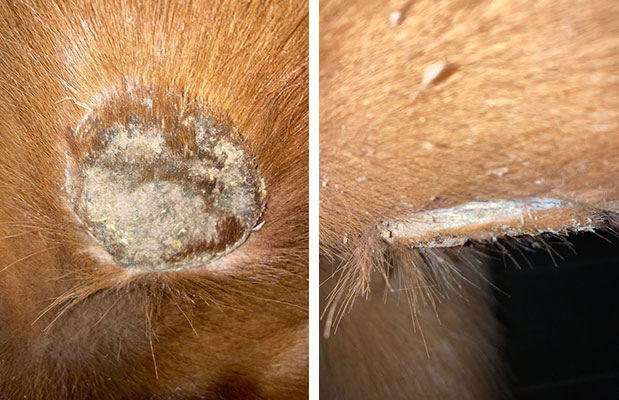
Verrucous sarcoid following AW5 treatment | Sarcoid starting to come away following treatment
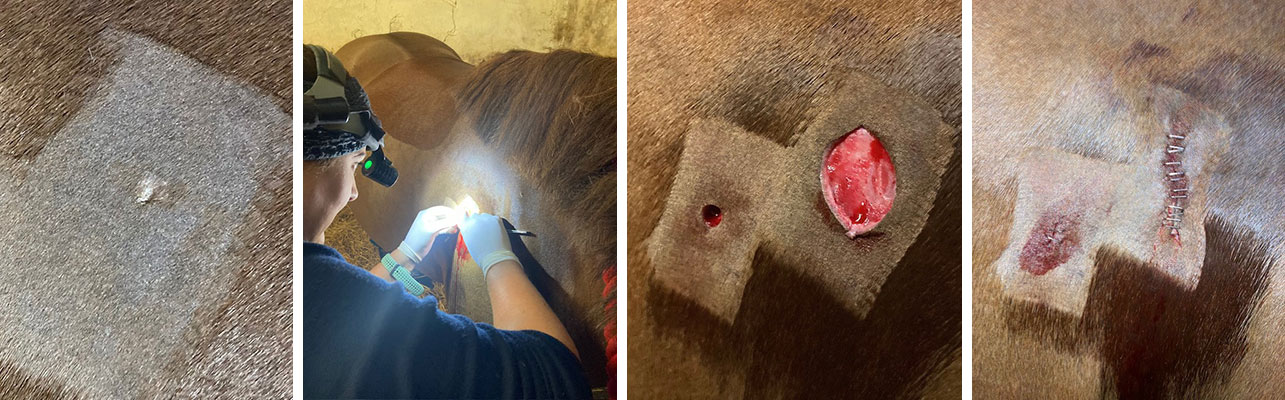
Example 3 – Sarcoid on the shoulder – removed surgically
Nodular sarcoid surgically removed on the shoulder of a horse
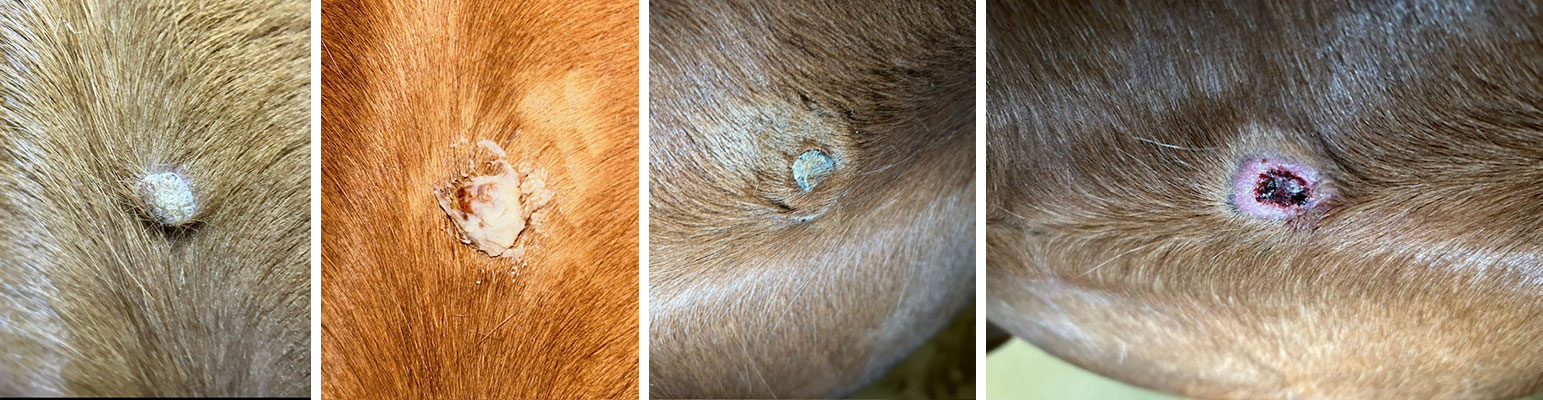
Example 4 – Sarcoid on the ventral abdomen – treated with AWS cream
Verrucous sarcoid on the ventrum | AW5 cream being applied | Sarcoid during treatment | Sarcoid following treatment once it’s fallen off